The locales that interest him are cosmopolitan ports that were at least partly incorporated into Western empires—cities such as Canton, Kuala Lumpur, Singapore, and Saigon, which were magnets for militants on the move. In these places, exiles from “lost countries”—a term Harper borrows from an activist of the time to refer to colonized lands—could evade arrest by the police by lying low in hard-to-patrol dockland districts.
… and this:
In subdivided cities like Shanghai, which had a British-dominated International Settlement beside a separate French Concession, they had another option: Base themselves in alleyway apartments in the jurisdiction of an empire other than the one they opposed, and take advantage of imperial rivalries that limited cooperation between the law enforcement arms of different powers.
President Trump has reportedly spent little time thinking about his post-presidential life. (“You can’t broach it with him,” an anonymous friend told the New Yorker in recent days. “He’d be furious at the suggestion that he could lose.”) But he will surely avail himself of the same consolation prize his predecessors did: a presidential library. What will it look like?
The federal presidential library system traces its origins to Franklin Roosevelt’s 1941 establishment of a library to make his records more accessible in the interests of transparency. But lack of funding and weak oversight by the National Archives and Records Administration mean that, without significant changes in the law, Trump will have a perfect pedestal where he can erect a shrine to himself. His records won’t be available in full until after he dies; he’ll be able to raise millions to award sinecures to his aides as they tout his supposed successes at “making America great again”; there is no mandate to pursue historical accuracy; he can whitewash his legacy. This will be the headquarters for Trump’s permanent post-presidential campaign.
And while Trump’s presidency was distinguished by constant departures from norms, the library is one place where all presidents are consistent. Following a trail blazed most successfully by Richard Nixon, turning his presidential library into an image-making prop will be among the most normal things Trump ever does.
This line is especially pithy:
The arc of presidential libraries bends toward loyalty, not truth.
Good tie-in to larger points about the seemingly never-ending, self-perpetuating character of American political campaigns:
With a big war chest, the hallowed “permanent campaign” of the modern presidency could achieve its final form in a foundation dedicated to burnishing Trump’s record. Such a foundation could easily generate enough revenue to support endless functions at Trump resorts, hotels and Mar-a-Lago. It could even prove a launchpad for political careers for the next generation of Trumps — or, given that the president would still be in his 70s, for Trump to pull a Grover Cleveland-esque comeback himself.
The writer and historian Jill Lepore has penned a great piece in the 23 November 2020 issue of the New Yorker (posted online 16 November). Her focus, in “Will Trump Burn the Evidence?“, is the politics of historical records and archives. It’s a great, topical essay that captures some of the anxiety about how the current Presidential transition period will unfold. It also usefully highlights tensions tugging at the professional practice of history.
There is no shortage of such challenges, as historians point out often enough. The one that I’ve been thinking through over the last few years, and that I think Lepore really draws out in her article, is the difference between public history, applied history, and forensic history. People who make a living studying and doing history will probably object to such crude categories, so to them I offer apologies in advance (with a promise to try to do better in future).
Public history, arguably the oldest and most mature of the three, is about memorializing and commemorating the past in a way that benefits the public. Applied history is currently trending but also has a history of its own, and fills a narrower, more particular niche: understanding and solving contemporary policy challenges through recourse to historical description and explanation. Forensic history is a complex beast, but sits somewhere between public and applied history, in its application of historical methods to issues of legal consequence.
Lepore’s piece is a wonderful read on the historical context for what to expect of the currently (outgoing) U.S. President’s attention to official records. She calls it an “evidentiary shell game”, which is sobering. For anyone interested in this kind of politics of information, it’s worth the time it takes to read it. Some great quotes:
Lepore, setting the stage:
Hardly a day passes that Trump does not attempt to suppress evidence, as if all the world were in violation of an N.D.A. never to speak ill of him. He has sought to discredit publications and broadcasts that question him, investigations that expose him, crowds that protest him, polls that fail to favor him, and, down to the bitter end, ballots cast against him. None of this bodes well for the historical record and for the scheduled transfer of materials from the White House to the National Archives, on January 20, 2021
Franklin Delano Roosevelt’s words, at the dedication of the US National Archives Building in 1941:
To bring together the records of the past and to house them in buildings where they will be preserved for the use of men and women living in the future, a Nation must believe in three things. It must believe in the past. It must believe in the future. It must, above all, believe in the capacity of its own people so to learn from the past that they can gain in judgements in creating their own future.
The historian Fredrik Lovegall, on private efforts to short circuit politically-motivated attempts in Washington to destroy documentary evidence:
I can imagine that at State, Treasury, D.O.D., the career people have been quietly copying important stuff all the way along, precisely with this in mind.
Lepore again, on the wider context – citing historical episodes from the destruction of libraries during the two World Wars of the 20th century, to its litany of occupations, genocides and civil wars:
National archives uphold a particular vision of a nation and of its power, and, during transitions of power in nations that are not democratic, archives are not infrequently attacked. Most attacks involve the destruction of the evidence of atrocity.
Regimes have done this to suppress evidence of brutality, dial back the national clock to year zero, and eliminate the documentary sources needed to hold the guilty accountable and enable survivors to recover. It’s a tough mix of international history and domestic patterns of political abuse that Lepore presents. I especially liked this pithy blurb, which highlights quite nicely the differences between primary and secondary sources, and what they mean for anyone involved in public, applied or forensic history:
Libraries house books: copies. Archives store documents: originals. Archives cannot be replaced.
Bernard Fall… nuclear strategist? One of the pieces of archival treasure I discovered among Fall’s personal papers is a document that reveals his awareness of and engagement with nuclear issues.
In a general sense, that’s a claim that could be made of just about anyone at the time. At the height of the Cold War, social and political anxieties over the prospect of nuclear war were real and pervasive. This was c. 1960-1961, right around the same time Fall was seeing Street Without Joy: Indochina at War, 1946-1954 – that quintessential artefact of Vietnam-era counterinsurgency – fully realized and published. Apparently he wasn’t busy enough, because meanwhile he was, according to what I found in his papers, also contributing expert input and analysis to a U.S Air Force Command and Staff College exercise.
It was a 24-hour affair a year in the planning, and focused on a hypothetical deployment of forces to Laos, then of much more immediate concern to U.S. policymakers than was Vietnam. In typical Fall style, he submitted a memoranda to exercise planners in which he tore apart the scenario they had developed for being completely “unrealistic” (underlined in the original memo). It was, he wrote, “so divorced from the military, political, terrain and even meteorological realities of war in Laos as to make any attempted solution along its lines unlikely to ever be applicable to Laos or to a similar situation.” He went on to detail exactly why this was the case, one paragraph per faulty scenario reality.
This is pretty standard Fall: when someone got their details wrong, he would basically eat them alive. But this wasn’t even the fun part. In addition to pointing out the flaws in the exercise design, he also offered a few observations about parts of it that could work, and it’s here that his engagement with nuclear practicalities comes through. Exercise participants were meant to include in their planning any and all possible options. The use of nuclear weapons was tabled, and one move that participants suggested was to disrupt cross-border logistics by nuking the mountain passes between Laos and North Vietnam.
Fall thought that while it might work on the ground units and bases in the area, Soviet airlift would limit its effectiveness. Use of battlefield nuclear weapons, on the other hand, could work in another way. “One new favorable factor is the creation by the Communists of a large supply center based on the three airfields of the Xien-Kouang Plateau (XK, Plaine des Jarres, and Phong-Savan). This does offer a valuable target inside Laos which no doubt can be taken out by small nuclear weapons.” It’s a striking comment, not least because it’s so far removed from the kind of subject matter for which Fall is remember these days.
Fall had made the occasional poetic allusion to nuclear anxieties in his military histories, but they were rare and fleeting and not the point of his published writing. The brutally unsympathetic nods to atomic Indochina contained in this exercise paperwork puts a different spin on things. And yes, this is a bit of shameless self-promotion: if you want the details and the source references, you’ll have to buy the book (or at least wait until it comes out, and then use Amazon to look inside and pilfer whatever details you need).
I often tell people that research on sanctuary in international politics – the subject of my forthcoming book, Streets Without Joy: A Political History of Sanctuary and War, 1959-2009, is a gift that keeps on giving. Streets is nothing if not the history of a concept, an account of its uses and continual reinvention in wartime American foreign policy. The useful and endlessly fascinating thing about concepts is that they operate in constellations of words and ideas that draw meaning and relevance from the contexts in which they arise. The equally addictive quality of historical investigation and discovery is that it periodically insists on yielding up sources that highlight and expand that web of meaning.
Here’s an excerpt from one that reinforces an analytical point I raise in Streets: that in geopolitical terms, it’s almost impossible – and quite ill informed – to think of sanctuary in the context of the war in Vietnam without thinking of a key Cold War corollary: neutrality (and by extension, hegemony):
VIENTIANE, Laos,May 30—To be Ieft untroubled by the East‐West conflict. Unmistakably this is what the great majority of the people of the Indochina Peninsula—the strife‑ tortured countries of Laos, Vietnam and Cambodia, mean when they speak of neutralism.
But the term is defined in diverse ways by the great powers locked in the struggle for influence in Southeast Asia. Neutralism has become a word that wanders in an international semantic jungle. For those who do not know the trails, it can be dangerous propaganda bait.
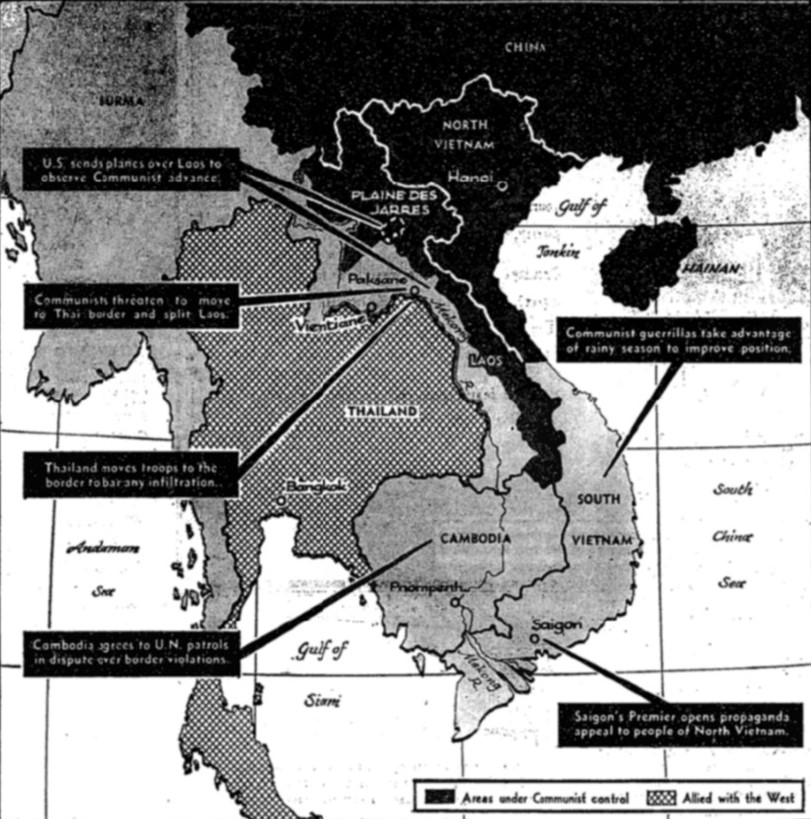
Here’s the map that accompanied it:
Source: Seymour Topping, “Neutralism in Indochina – Threat or Panacea?” New York Times (31 May 1964), p. E4.
 MICHAEL A. INNES