New Article at Foreign Policy

I’ve got a new piece up at Foreign Policy on “COIN confusion“, that peculiar merging of counterinsugency and counterterrorism policies in Afghanistan. I was fortunate – if I can make that claim of such a dark issue – in that an individual of questional mental capacity, Faisal Shahzad, had just tried to set off a truck bomb in New York City’s Times Square. You can imagine the snowstorm of punditry that followed, basically calling down the suspected terrorist and others like him as morons (Note: it wasn’t that long ago that there was supposed to be a preponderence of trained engineers among jihadi terrorists. I don’t know if that’s supposed to be a positive for terrorist acumen or a negative for engineer intellect, but I digress…).

The ongoing discussion of the attempted Times Square bombing in New York has been unsurprisingly colorful. New York Mayor Michael Bloomberg invoked the old saying that terrorists only need to be lucky once, while their opponents need to be lucky every time — and this time, we were “very lucky.” The New Republic‘s Jonathan Chait and former NYPD Deputy Commissioner for Counterterrorism Michael Sheehan noted the incompetence of most plotters, Chait with the memorable assertion “terrorists are basically dolts,” Sheehan suggesting that “lone wolves” are generally “as incompetent as they are disturbed.”

Always open with a good hook… anyway, that was a useful entree into subsequent commentary about how well the NYPD handled things, and the strides it’s taken since 9/11 to beef up its capacity for dealing with real and potential with terrorism. That’s a bit of a mouthful – “capacity for dealing with real and potential terrorism”. Why not just call it “counterterrorism”? Talking and writing about those capacities gets hung up on a few jurisdictional issues: domestic and foreign policy operate under different guidelines, constraints, beliefs, expectations, and tools. The big ones, when it comes to terrorism, are policing and military measures, and their associated doctrines – one of which, at least the one I’m familiar with, is that there’s a big, well-defined distinction between anti-terrorism and counter-terrorism. Anti is about mitigating risk – policing, preparation, limiting vulnerability to terrorist attack. Counter is about proactively going out and doing something about the terrorists themselves, whether it means putting them on trial and locking them up or launching a brace of Hellfire missiles into a training camp in Pakistan’s Northest Frontier Province.

Whither “anti” terrorism? Gone the way of the dodo, it seems, at least in the way we frame it. Maybe we need to revisit it, as a way past the counterterrorism and counterinsurgency policy tug of war that the University of St. Andrew’s Michael J. Boyle writes about so eloquently and incisively in the March 2010 issue of International Affairs.

Cross-posted from Current Intelligence
CTlab Spin-Out Project

I’ve spent the better part of the last week building a new site for CTlab’s Current Intelligence blog, which at some point in the next couple of weeks will be migrated out from under CTlab housing into its own domain and platform. For those who’ve been following CI, the first thing you’ll probably notice is the greatly expanded format: CI will no longer be one blog, but many; moreover, it won’t be many blogs, but multiple columns and sections… the format, in general, will be something more akin to what we used to call a “magazine”. That’s the direction in which I’m taking it, and the prospect is exciting.

Recent Reads: Metaphors, Architectures of Conflict, and Forever Wars

Since leaving the day job to focus on research and writing, I’ve been nose-deep in readings of one kind or another, and thoroughly enjoying the experience. Some recent reads that are worth your time:

____________________________________________________________________

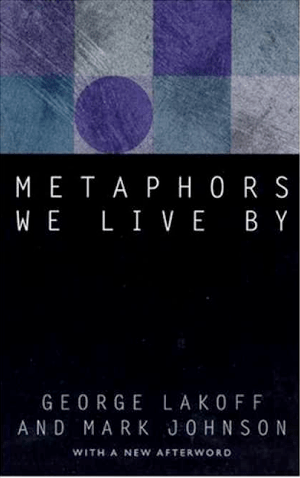
Metaphors We Live By. Illuminating, but infuriatingly limiting. This classic from Berkeley cognitive linguist and Democratic party framing guru George Lakoff (along with co-author and much less feted Mark Johson) was the first of a long reading list I’m exploring on analogical reasoning. Its emphasis on textual analysis strikes me as both culturally contingent and missing some key insights from the realm of material culture on artefact transfer and physical metaphor. Still, an absolutely essential read. It left me wondering, too, about Lakoff’s involvement in politics. He spent a career developing theories of metaphor, but became a guru on framing – which is a distinct realm of thought, albeit as multidisciplinary as that of metaphor. Did Lakoff reframe himself to better appeal to an audience?  A cynical thought. I’m not yet sufficiently familiar with the corpus of Lakoff writing to detail whether his work on framing pre-dates his public persona as the political go-to guy on the subject – or indeed, whether he ever bridged his thinking on metaphor with frame analysis, implicitly or explicitly. I’m looking forward to finding out.

____________________________________________________________________

The Edifice Complex. One of the angles I’ve been pursuing in my research deals with the interface between architecture and conflict. This book is an excellent primer.  Deyan Sudjic, former architecture critic for The Observer newspaper, ranges widely on the creepy flirtation between architectural practice and the political and financial context that shapes its output. The prose is accessible, frequently witty and acerbic, and the text is thick with historical color. Anyone who’s followed recent debates in American academia on the relationship between social sciences and the military will also appreciate Sudjic’s text: its privileged glimpse into the world of disciplinary hubris and rampaging ego makes anthropologists in Iraq and Afghanistan look like a pretty modest bunch by comparison.

____________________________________________________________________

The Forever War. NYT’s foreign correspondent Dexter Filkins‘ memoir of almost four years in Baghdad, from the 2003 invasion through the height of Iraq’s insurgency, is one of the most compelling war diaries I’ve ever read. Filkins claims to have been careful in how he went about his business, taking measures to mitigate the dangers he exposed himself to, but you wouldn’t know it from the quality of his reporting. Whether embedded with Marines in the battle of Faluja or going for solitary runs along the banks of the Tigris River to maintain his sanity, Filkins repeatedly frames his experience as a prolonged exercise in psychic alienation. Architectural metaphors abound: his characterizations of the Green Zone, as well as the NYT’s own increasingly fortified compound, are similarly hard reminders of the difficulties involved in knowledge formation in crisis zones.

____________________________________________________________________

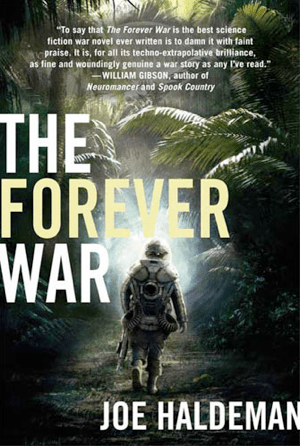
The Forever War. I originally read Filkins’ The Forever War because I wanted to know whether his text was meant to be a tribute to Joe Haldeman’s post-Vietnam science fiction classic, first published in the late 1970s. This is the original Forever War, about a military campaign that takes a 1000 years to fight. Force projection in this tale requires jumps of hundreds of light years, and due to the dynamics of relativity, the few soldiers who survive their missions only age by a handspan of years while the rest of humanity has leapt forward by centuries. The cultural disconnects and social alienation experienced by veterans, inspired by Haldeman’s own experiences in Southeast Asia, are amplified and extended: English has become an archaic language maintained only for communication with returning troops, humanity develops into a cloned hive-mind, and veterans settle on an isolated planet where they can be among their own kind. The book was contentious when it was first published, and an entire section on the revolt of the post-war settler-veterans was initially left out – so if you get a chance, read the later omnibus edition, which includes the full story. (Note: apparently, Ridley Scott will be using the film technology James Cameron developed for Avatar to adapt this classic  to the big screen. One to watch.).

The Military-Evangelical Complex

Noted at Juan Cole’s Informed Comment, as item 4 in a list of Top 10 Counterterrorism Scandals 2010:

George W. Bush claimed that he had misspoken when he called his ‘war on terror’ a ‘crusade.’ But it turns out that the Michigan company that makes rifle sights for the US military inscribes them with Bible verses. The capture of the US Air Force Academy by Christian fundamentalists is worrisome enough, but a Military-Evangelical Complex is truly frightening.

What to say? One more in a litany – pardon the term – of similar cases. I want to write something about prepubescent states that pretend to maturity and adulthood…