Syria’s Heritage at Risk

One of the recurring headlines of the war in Syria details the destruction of its precious cultural artefacts. It has become a truism of sorts that when locations are struck by artillery and mortar fire, it isn’t just human bodies and communities being destroyed but human heritage, as well. Ancient architecture is being stress-tested in ways that its designers and builders are unlikely to have foreseen. Only two weeks ago UNESCO head Irina Bokova decried damage done to the Crac des Chevaliers and the Qal’at Salah El-Din, both “outstanding examples” of the “region’s fortified architecture”. The sites were among six being placed on a UN List of World Heritage in Danger, alongside “The Ancient City of Damascus”; “Site of Palmyra”; “Ancient City of Bosra”; “Ancient City of Aleppo”; and “Ancient Villages of northern Syria”.

That Syria’s architectural and archeological treasures were at extreme risk of war damage is certainly newsworthy, but it is not new. Stories of similar abuses and losses have been filtering out of the region since the fighting began two years ago. One of the most striking of these emerged only days ago, recounting the organised looting of historic sites including that of an ancient Hellenic city, Apamea, located about 55km northwest of Hama and thought to have been founded around 300 B.C. A Bloomberg headline read “Syrian Looters In Bulldozers Seek Treasure Amid Chaos.” An excellent  research project at the University of Glasgow entitled “Trafficking Culture” (traffickingculture.org) provides incredible satellite images of the Apamea site at the beginning of the conflict – flat, unspoiled, uncratered – and later images showing a wildly perforated vista – a “moonscape blighted by hundreds  upon hundreds of holes” – where, one assumes, not a single artefact of value has been left behind.

If the litany of cultural destruction seems wanton, extreme, and depressing, consider that Syria is only the most recent example of it. Early this year, reports from Mali were that Al Qaeda and affiliated extremists who had occupied parts of the country were destroying rare, priceless manuscripts and other artefacts in Timbuktu and Bamako. Extremists fleeing the former in the face of advancing French  troops made sure to set alight a library before leaving. Such scenes recall previous instances of at-risk heritage suffering the vicissitudes of war and instability. In 2003, during the US invasion of Iraq, looters had their way with the country’s National Museum in Baghdad. In 2001 the Taliban dynamited two giant Buddha statues in Bamiyan, Afghanistan. In 1992, during the siege of Sarajevo, Serbian artillery gunners shelled the city’s Ottoman-era national library into oblivion.

Sometimes, recovering these treasures is simply impossible. In Sarajevo, the flames that engulfed the library ate over 1.5 million volumes and 150,000 rare books and manuscripts, most of them unique and irreplaceable. The Buddhas of Bamiyan are gone forever; rubble, tourist photographs and the empty spaces they once occupied the only evidence that they even existed at all. In Mali, reports of burning libraries and destroyed manuscripts are matched by encouraging tales of rescue and preservation, of efforts taken to dupe the extremists and hide the country’s priceless legacy. Conditions in Syria seem  less hopeful, the damage of such a scale and so pervasive that it is difficult to imagine what postconflict recovery might look like. But we can hope, and we can imagine, and we can go even further than that: we can observe, and record, and plan, and eventually rebuild.

Originally published in Current Intelligence 5:3 (Summer 2013), p. 34.
Recent Reads: Metaphors, Architectures of Conflict, and Forever Wars

Since leaving the day job to focus on research and writing, I’ve been nose-deep in readings of one kind or another, and thoroughly enjoying the experience. Some recent reads that are worth your time:

____________________________________________________________________

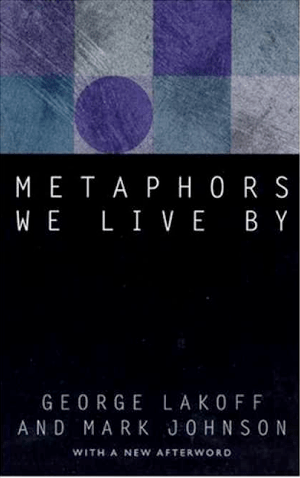
Metaphors We Live By. Illuminating, but infuriatingly limiting. This classic from Berkeley cognitive linguist and Democratic party framing guru George Lakoff (along with co-author and much less feted Mark Johson) was the first of a long reading list I’m exploring on analogical reasoning. Its emphasis on textual analysis strikes me as both culturally contingent and missing some key insights from the realm of material culture on artefact transfer and physical metaphor. Still, an absolutely essential read. It left me wondering, too, about Lakoff’s involvement in politics. He spent a career developing theories of metaphor, but became a guru on framing – which is a distinct realm of thought, albeit as multidisciplinary as that of metaphor. Did Lakoff reframe himself to better appeal to an audience?  A cynical thought. I’m not yet sufficiently familiar with the corpus of Lakoff writing to detail whether his work on framing pre-dates his public persona as the political go-to guy on the subject – or indeed, whether he ever bridged his thinking on metaphor with frame analysis, implicitly or explicitly. I’m looking forward to finding out.

____________________________________________________________________

The Edifice Complex. One of the angles I’ve been pursuing in my research deals with the interface between architecture and conflict. This book is an excellent primer.  Deyan Sudjic, former architecture critic for The Observer newspaper, ranges widely on the creepy flirtation between architectural practice and the political and financial context that shapes its output. The prose is accessible, frequently witty and acerbic, and the text is thick with historical color. Anyone who’s followed recent debates in American academia on the relationship between social sciences and the military will also appreciate Sudjic’s text: its privileged glimpse into the world of disciplinary hubris and rampaging ego makes anthropologists in Iraq and Afghanistan look like a pretty modest bunch by comparison.

____________________________________________________________________

The Forever War. NYT’s foreign correspondent Dexter Filkins‘ memoir of almost four years in Baghdad, from the 2003 invasion through the height of Iraq’s insurgency, is one of the most compelling war diaries I’ve ever read. Filkins claims to have been careful in how he went about his business, taking measures to mitigate the dangers he exposed himself to, but you wouldn’t know it from the quality of his reporting. Whether embedded with Marines in the battle of Faluja or going for solitary runs along the banks of the Tigris River to maintain his sanity, Filkins repeatedly frames his experience as a prolonged exercise in psychic alienation. Architectural metaphors abound: his characterizations of the Green Zone, as well as the NYT’s own increasingly fortified compound, are similarly hard reminders of the difficulties involved in knowledge formation in crisis zones.

____________________________________________________________________

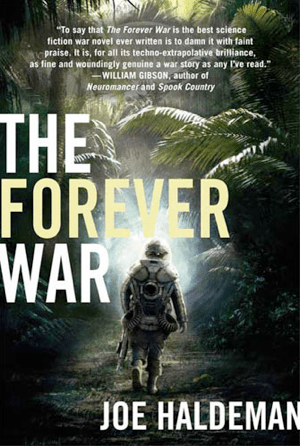
The Forever War. I originally read Filkins’ The Forever War because I wanted to know whether his text was meant to be a tribute to Joe Haldeman’s post-Vietnam science fiction classic, first published in the late 1970s. This is the original Forever War, about a military campaign that takes a 1000 years to fight. Force projection in this tale requires jumps of hundreds of light years, and due to the dynamics of relativity, the few soldiers who survive their missions only age by a handspan of years while the rest of humanity has leapt forward by centuries. The cultural disconnects and social alienation experienced by veterans, inspired by Haldeman’s own experiences in Southeast Asia, are amplified and extended: English has become an archaic language maintained only for communication with returning troops, humanity develops into a cloned hive-mind, and veterans settle on an isolated planet where they can be among their own kind. The book was contentious when it was first published, and an entire section on the revolt of the post-war settler-veterans was initially left out – so if you get a chance, read the later omnibus edition, which includes the full story. (Note: apparently, Ridley Scott will be using the film technology James Cameron developed for Avatar to adapt this classic  to the big screen. One to watch.).

The Military-Evangelical Complex

Noted at Juan Cole’s Informed Comment, as item 4 in a list of Top 10 Counterterrorism Scandals 2010:

George W. Bush claimed that he had misspoken when he called his ‘war on terror’ a ‘crusade.’ But it turns out that the Michigan company that makes rifle sights for the US military inscribes them with Bible verses. The capture of the US Air Force Academy by Christian fundamentalists is worrisome enough, but a Military-Evangelical Complex is truly frightening.

What to say? One more in a litany – pardon the term – of similar cases. I want to write something about prepubescent states that pretend to maturity and adulthood…

The Junior Officers’ Reading Club

Christopher Coker of the London School of Economics and Political Science (I always want to render the “and Political Science” in parentheticals, for some reason) has an interesting review of two new books in the Times Literary Supplement: Patrick Hennessey’s The Junior Officers’ Reading Club: Killing Time and Fighting Wars and James Fergusson’s A Million Bullets. It’s a short review, but it’s a more accurate, and apt, characterization of the two authors’ subjects (Iraq and Afghanistan) than I’ve read anywhere else. This blurb on NATO struck a chord:

Traditionally soldiers have read books to orientate themselves, either to make sense of their personal experience of war or to have a greater understanding of the larger picture, “what it’s all about”. Churchill tells us he was spurred on to study by catching himself using a good many words, the meaning of which he could not define properly. What would he make of war today? As Matthew Parris pointed out in The Times, the NATO mission in Afghanistan is a semantic nightmare: “agent for change”; “assymmetric means of operation”; “capacity building”; “conditionality demand reduction”; “injectors of risk”; “kinetic situation”; “licit livelihood”; “light footprint”; “partnering and mentoring”; “reconciliation and reintegration”; “rolling out a touchdown approach”; “upskilling”. Today’s soldiers (or “stability enablers” as NATO prefers to call them) are lost in jargon. It represents both a lack of real conviction in policing the frontier, an embarrassment about war itself, and a confusion about the operational purpose, which always seems to be changing. Afghanistan is a tactically, not strategically, driven war as objectives and goals are recalibrated (usually downwards) according to success or failure in the field.

Read the rest here.